Mending in Plain Sight
A guest essay from a textile mender on why visible repair is not a trend but a plain statement of fact, and how to darn a hole in a wool sock in four honest steps.
In this essay
When a customer brings me a jumper with a hole in the elbow, the first question I ask is not whether it can be mended. It nearly always can. The first question is whether they want anyone to know.
For the first ten years of my working life the answer was always no. Invisible mending was the highest skill in the trade: a woman at the back of a dry cleaner’s could take a cigarette burn out of a suit and leave nothing. I learned it. I was good at it. And then, on a quiet afternoon, I realised that I was spending my career making evidence vanish.
Why I stopped hiding it
A hole in a garment is a record. It says where the garment was worn, where it caught, where it was loved. Hiding it makes the object look unused, which is a kind of lie, and a very small one. I found that the people who came back to me were not the ones who wanted a perfect disguise. They were the ones who wanted the thing to carry on, with its history intact.A tailor once told me that the best compliment a customer can pay is to bring the same garment back. By that measure I have done my best work on the same four jumpers.
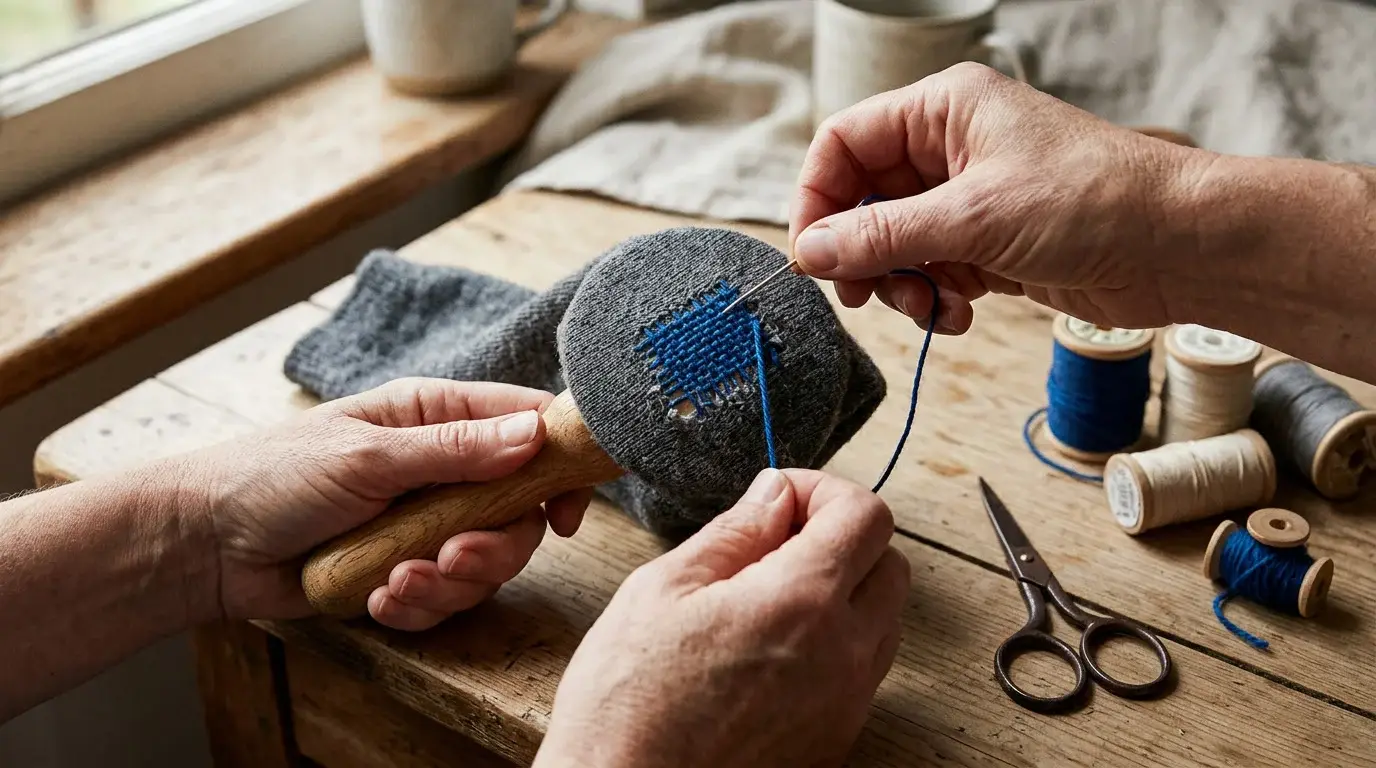
Visible mending takes the opposite position. You do not conceal the repair. You do the work in a thread that shows, in a pattern that is deliberate, and you let the patch be part of how the garment looks. The result is rarely subtle. A blue darn on grey wool is not hiding anything.
A darn, in four steps
The simplest repair is also the oldest. You need a needle with a large eye, a darning mushroom or a smooth jar, and a length of thread a little thinner than the fabric.
- Prepare the hole. Trim any loose threads at the edge, but do not enlarge it. Slip the mushroom inside the sock so the fabric lies taut and flat.
- Lay the warp. Starting a little beyond the hole, on firm fabric, run parallel stitches across the gap, close together. These are the foundation. Leave a little slack at each turn; wool shrinks.
- Weave across. Turn the work and pass the needle over and under the warp threads, one by one, working row by row. The pattern is plain weave, the same one your grandmother used.
- Secure the ends. Take the thread out through the surrounding fabric and snip it. Do not knot it: a knot becomes a bump in a shoe.
The whole job takes about an hour for a sock, and perhaps a little less once your hands know the pattern.Wool darning thread is sold in small skeins in a range of colours. Cotton embroidery thread also works, though it wears faster; for socks, a fine wool is best. The result is a small woven patch, tough in exactly the place where it was thin.
The bit nobody says
There is a risk that visible mending turns into decoration, a fashion you buy rather than a fact you accept. I see it already: brightly coloured thread on clothes that have no holes. This misses the point. A repair is only honest if the damage came first.
I do not mean this as a rule. People should mend however they like. But I have noticed that the repairs I keep, the ones I return to and admire, are the ones that began with real wear. The elbow worn through at the desk. The knee that finally gave on a hill. The heel of a sock, where a person walked.
The garment is not worth less for having been mended. It is worth more, because someone looked at it, and decided it deserved another few years.The English word “mend” comes from the same root as “amend”: to make better, not to make new. The distinction is worth keeping.
If you want to start
Begin with a sock. They are cheap, the hole is small, and you will not be heartbroken if the first one is ugly. Use a thread that contrasts. Take your time. And when you have finished, wear it with the darn showing, in your shoes where no one will see, and enjoy knowing that it is there.
If this was worth your time, there is a letter.
One short letter every Friday. No tracking, leave in one click.