Bread Without a Timer
A year of baking one loaf a week taught me that dough is not a recipe but a conversation, and that the clock on the oven is the least informative thing in the kitchen.
In this essay
For the first year I baked bread with a timer, and the bread was fine. It was fine the way a well-spelled letter is fine. Every crumb was where the recipe said it would be, and none of it made anyone put down a fork.
Then one Sunday the timer broke, in the practical sense that I forgot to set it, and the loaf that came out of the oven was the best I had made. I have been trying to understand why ever since.
What the recipe cannot see
A recipe is a snapshot of one kitchen on one day. It tells you the dough should rise for ninety minutes, because ninety minutes was how long it took for the person who wrote it, in a kitchen at twenty-two degrees, with flour from a particular mill and a starter of unknown age and temper.
Your kitchen is not that kitchen. In October mine is eighteen degrees by the window and twenty by the stove. The flour is from a different mill, and drinks more water than the book allows for. The starter has been on the counter for three days and is, by any reasonable standard, in a mood. So when the recipe says ninety minutes, it is not wrong. It is merely answering a different question.
Reading the dough instead
The loaf that worked was one I made by looking. Not at the clock, at the dough.
- It grows by about half. Not double, not “until it looks puffy”. Press a floured finger into the side; if the dent springs back slowly and not quite fully, it is ready.
- It smells different. A sweetness at first, then something sharper, like the cellar of a cider farm. When the sharpness arrives it is nearly done.
- It changes its surface. A shiny, tight skin at the start; a slightly slack, matt one at the end.
None of these takes more than a glance, and all of them are more reliable than a number printed in a book. The finger test in particular I had been taught as a trick for people who cannot be trusted with timers. It turns out to be the other way round.
The pace of the loaf
Dough lives on its own schedule, and a kitchen run by a clock rarely agrees with it. There were Sundays when it was ready at four and I was out. There were Sundays when it needed another hour and I wanted my supper. Both ended in bread, and in neither case did the bread suffer for my impatience, because I had stopped treating the dough as something that was late.
What changed was my relationship to waiting. When there is a timer, waiting is a countdown, an interruption between the real events. When there is none, waiting is the middle of the job. I fold the dough, I leave the room, I come back and look. I have read most of a novel in the gaps. The dough does not mind. It is, if anything, a better reader’s companion than a phone.
What to do on Saturday
If you want to try this, the method is short.
- Mix flour, water, salt and a spoonful of active starter in the evening. Do not measure anything with great precision. Aim for a dough that holds its shape but sags.
- Cover it with a damp cloth and leave it, somewhere not too warm, overnight.
- In the morning look at it. It should have grown, smell sour-sweet and feel slightly springy. If it has not, wait. If it has, shape it.
- Let the shaped loaf rest, again, until the finger test says it is ready. This is the part you have to trust.
- Bake in a hot, heavy pot with the lid on for half an hour, and then with the lid off until the crust is the colour of strong tea.
You will notice there is no minute count for the rise. That is the point. Use the finger. Use your nose. Look at it every twenty minutes if you have to, like a person looking at a sleeping child.
An imperfect loaf
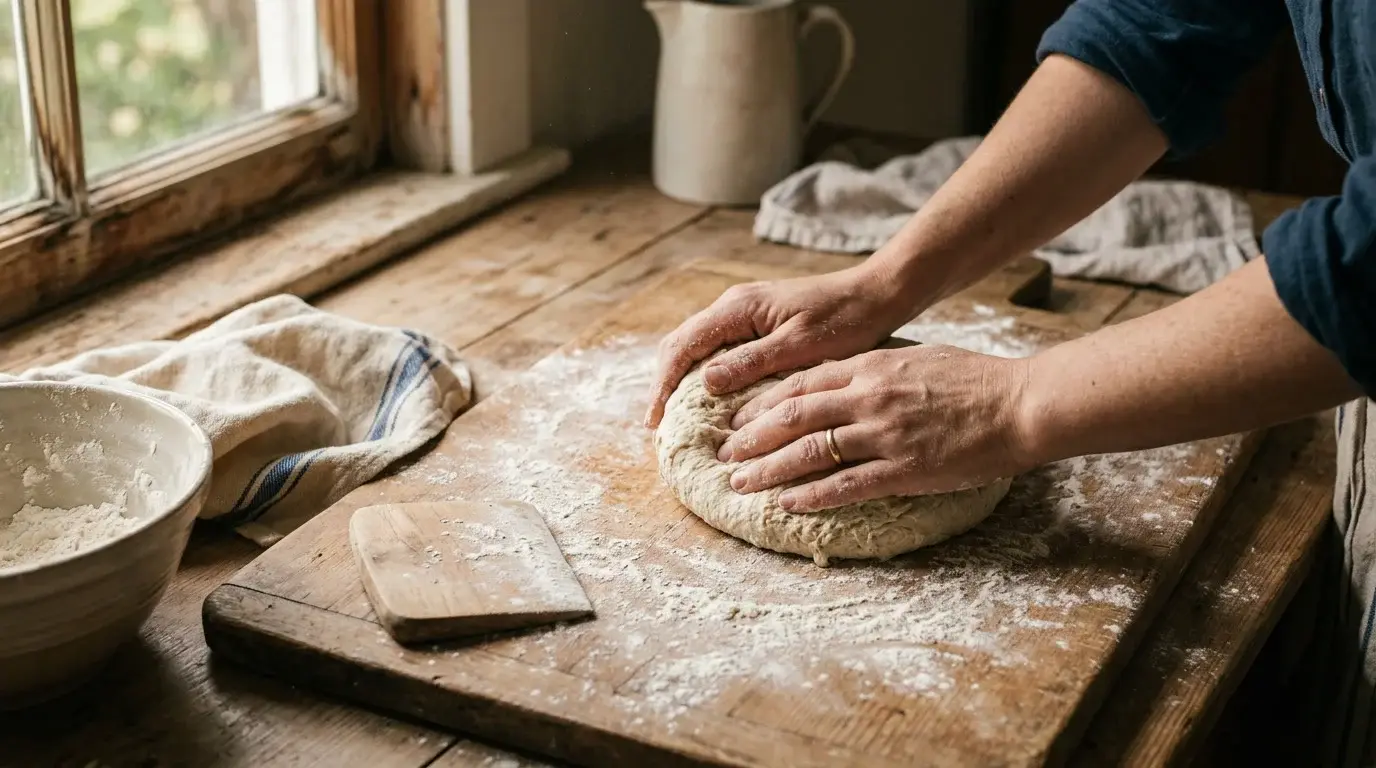
The loaf in the photograph is not the one that changed my mind. That was eaten. This one is lopsided and its crust is slightly too dark on the left, because the pot has a hot spot I have still not learned to avoid. I mention it because I had a moment of vanity, in front of the camera, when I wanted to bake a better one. I did not. I shot the one I had.
Bread is a long argument with a living thing, and the dough always gets the last word. I am learning, slowly, to listen to it.
If this was worth your time, there is a letter.
One short letter every Friday. No tracking, leave in one click.