Sharpen First
Every woodworking teacher says it, and every beginner skips it. A long morning with a chisel and a stone, and why the first hour of any job belongs to the tool.
In this essay
The first thing Walter taught me, in a cold workshop above a failed bakery, was that I had not yet started. I had arrived with a plank of ash, a drawing and what I thought was enthusiasm. He took the chisel out of my hand, looked at its edge against the window, and gave it back. “Sharpen first,” he said. “Then we’ll see what you wanted to make.”
It took me most of a morning. I was not good at it, and the morning was the lesson.
What sharp actually means
A sharp edge is not a thing you have, like a coat. It is a state you keep reaching. Two flat surfaces meet at a line, and the line is sharp only if both surfaces are polished right up to it. Most dull chisels are not dull along the whole edge; they are dull in one tiny place where a surface was never quite finished.A magnifier helps. At ten times magnification a “dull” edge often turns out to have a single shiny nick, a chip the size of a grain of salt, with the rest perfectly keen. That is why sharpening feels like fussing. You are not removing metal. You are removing doubt.
The test Walter used was almost insulting in its simplicity: hold the chisel up to the light and look at the edge head-on. A truly sharp edge reflects nothing, because there is no flat spot to catch the light. A dull one shows a thin bright line, and the line is the problem. Mine showed a bright line along about a third of its length. “That’s the bit that will tear your ash,” he said.
The stone, in three motions
The sequence is the same for every edge, and it is short enough to learn in an evening and long enough to practise for years.
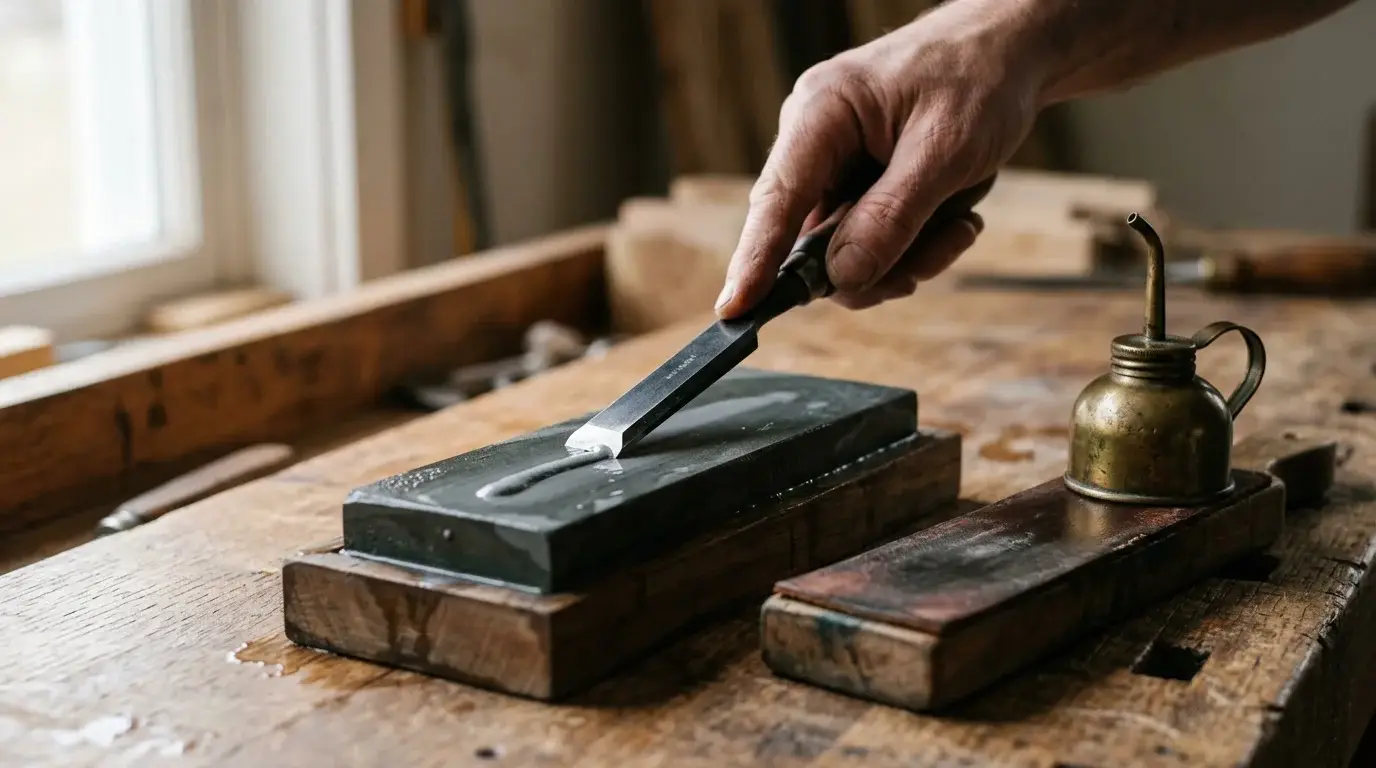
- Flatten the back. The flat face of the chisel must be flat for the first inch behind the edge. Lay it on a coarse stone, press with two fingers near the tip, and work it until the scratch pattern runs uninterrupted to the edge. This is dull work and the most important part.
- Raise a burr on the bevel. On a medium stone, hold the angle steady (about 25 degrees) and push until a tiny curl of metal, the burr, appears on the flat side. You find it with your thumbnail, not your eyes.
- Polish both sides. A fine stone, then a leather strop dressed with a pinch of green compound. A few strokes each side, and the edge disappears from the light.Green stropping compound is a very fine abrasive wax. Use less than you think, and keep the strop for edges only; the first time you strop a chisel’s back you will round it, and the lesson is expensive.
The ten minutes that save an afternoon
I used to treat sharpening as an interruption: something that happened when the work stopped. Now I think of it the other way round. The work is what happens in the gaps between sharpenings.
The numbers are persuasive, if you like numbers. A dull chisel makes you push harder, which makes you less accurate, which makes you correct, which makes you push harder again. A sharp one needs only the weight of your hand.Walter’s rule of thumb: if you can feel yourself holding your breath, the tool is dull. Sharp work is done on the out-breath. I have timed myself paring the same tenon cheek with a chisel straight from the drawer and with one freshly stropped. The sharp one took four strokes. The other took eleven, and left a surface I had to apologise for.
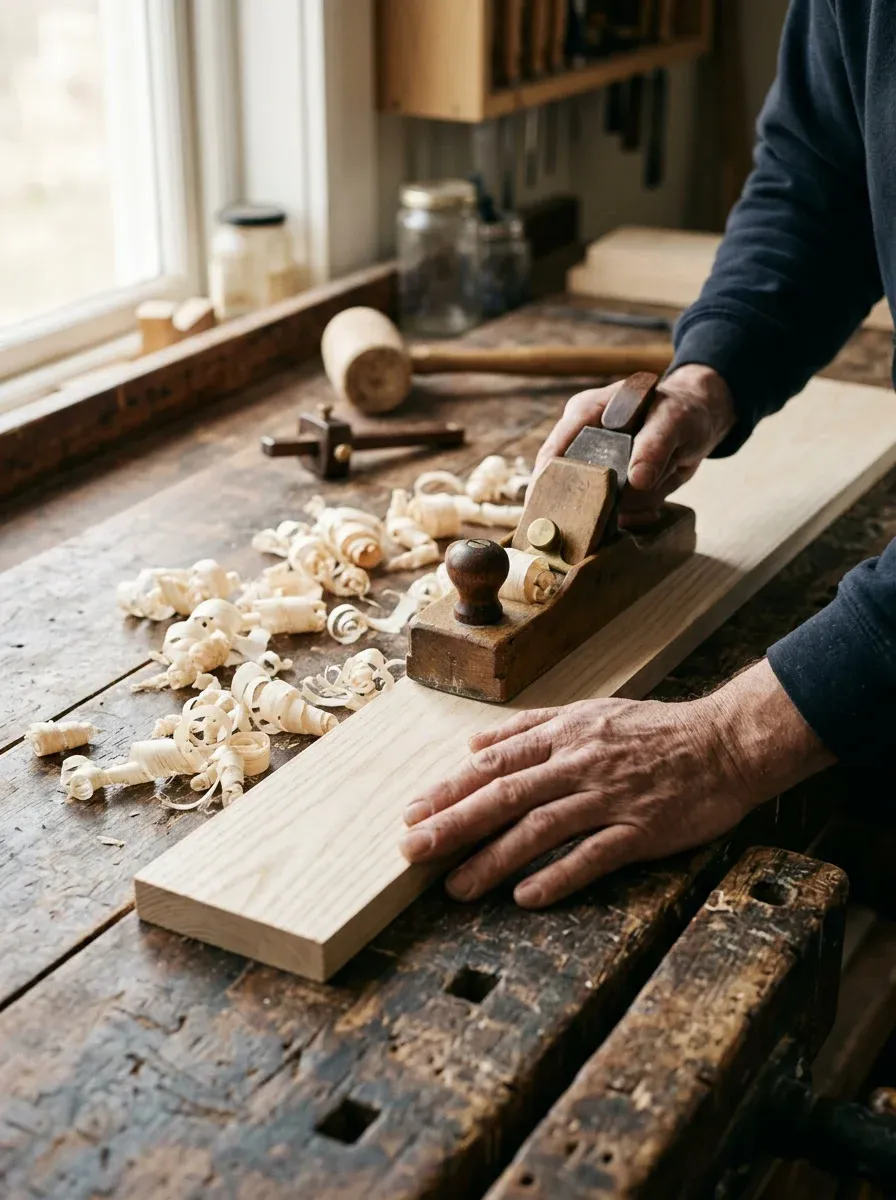
There is a second effect, harder to measure. When a tool is sharp, the work gets quiet. There is a sound a sharp plane makes in ash, a long dry whisper, that tells you before your eyes do whether you are doing it right. With a dull plane the same pass is a grumble, and you start to hear your own impatience in it.
Where the habit goes next
I have started to wonder how many other jobs have a hidden first hour. A cook who tastes the salt before seasoning. A printer who checks the ink on a scrap sheet. A writer, perhaps, who reads the last paragraph of yesterday’s page aloud before beginning today’s. None of these is the task itself, and each decides whether the task goes well.I tried the last one for a month. It is irritating, it works, and the exact amount of improvement is the sort of thing I would rather not look at too closely.
Walter never asked what I had wanted to make. By the time the chisel passed his window test it was nearly noon, the light had moved across the bench, and the plank of ash was still exactly as I had left it. “Right,” he said, putting the kettle on. “Now you can begin.” I made a small stool that week. It wobbles, and I would not trade it.
If you take one thing from this essay, let it be small: this week, before the next job that needs a blade, spend ten minutes on the stone. Notice what changes. Then tell me, because I collect the answers.
If this was worth your time, there is a letter.
One short letter every Friday. No tracking, leave in one click.