A Book in Three Parts, part 2 of 3
Sewing the Text Block
Linen thread, a needle, and the quiet discovery that every stitch has to be right before the next one can begin.
In this essay
Sewing is the stage of bookbinding I was most afraid of, and the one I now think about when I cannot sleep. There is nothing complicated about it. You pass a needle in and out of the fold of each signature, loop the thread around a cord, and move on. But every stitch you make is inside the book, and no stitch can be seen when it is finished.
You do it right, or you do it again.
The frame and the cords
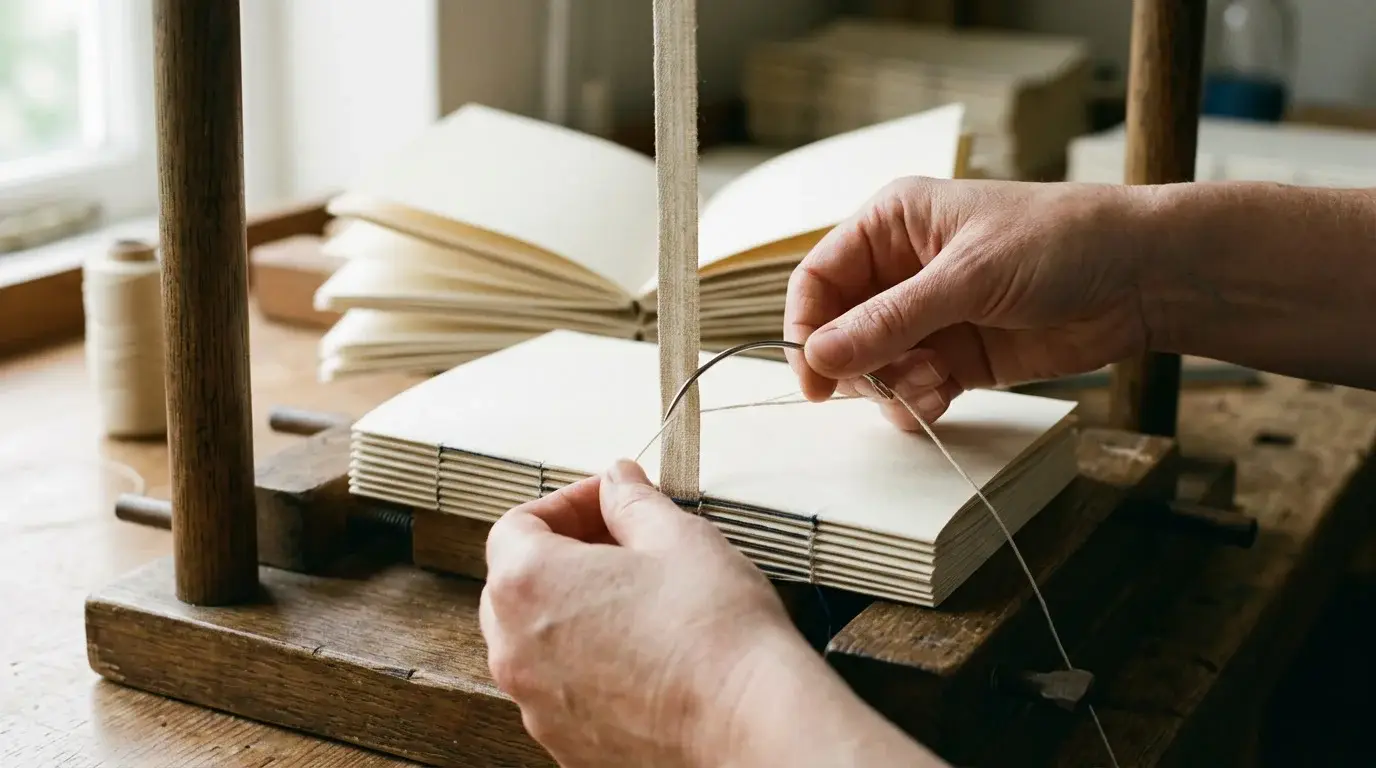
The text block, as the sewn stack is called, is held together by thread that runs up and down the spine of each signature and is looped around horizontal cords as it goes. In my case there were four cords of unbleached linen, held taut on a wooden frame that a friend in the workshop had made from two uprights, a base and a lot of confidence.A sewing frame is one of the simplest tools in the trade: a flat base, two vertical posts, a crossbar and some kind of tensioner. They are sold in the hundreds of pounds and can be made in an afternoon from offcuts.
The first signature goes on the frame, the fold against the cords. Then you thread a curved needle with waxed linen, which is thread that has been drawn across a block of beeswax until it is stiff and slightly tacky. Wax stops the thread from fraying and lets it grip, and, with a hundred and fourteen stitches ahead of you, you will want it to grip.
The stitch, in four moves
The pattern is called kettle stitch at the ends and a simple weave between. I did not know either word when I started, which turned out not to matter.
- Go in at the first hole, from outside the fold to inside.
- Come out at the second hole, and loop around the cord.
- Go back in at the same hole and continue.
- At the end of the signature, tie off and begin the next.
Written out it looks like a recipe. In the hand it is a rhythm, and the rhythm matters because it is the only thing that tells you when something is wrong. Each pull should feel the same. A stitch that is too tight puckers the paper; too loose and the spine will gape. After the first dozen I stopped looking at my hands and started listening to the thread, which makes a tiny dry sound as it comes through paper. A wrong stitch makes a different sound.The sound is harder to describe than to hear. A good stitch pulls through with a faint rasp, like fine sandpaper on pine. A bad one sticks, then squeaks. If you hear the squeak, stop.
What the slowness does
I sewed one signature a night for a week. I could have done it faster, and a more efficient version of me would have done all seven in a Saturday. But there was something I had not expected: the evenings were quiet in a way my working days were not. I would sit down at nine, thread the needle, and by the second signature the day had stopped following me.
Craft writers have a word for this, and I distrust the word, so I will describe it instead. The task is small enough to hold in your head, hard enough to need your hands, and slow enough that the thoughts you are not having have time to leave. It is not meditation. It is closer to washing up, if washing up produced a book.
The mistake I had to keep
On the fifth signature I realised that I had missed a kettle stitch at the head. The fix is to unpick the signature, back to the last good loop, and re-sew it. I knew this. I also knew it was ten at night, the thread had a small knot I did not trust, and the book was going to be hidden behind a cover. I carried on.
It is the only decision on this project I regret. You cannot see it, and you cannot forget it. When I open the finished book, the head of the fifth signature sits a hair higher than its neighbours. The book is perfectly sound, and I will know it for the rest of its life.
That, I think, is the real difference between hand work and everything else. In an ordinary job, a hidden fault is a risk. In a craft, it is a witness.
Where we stand
By Friday the seven signatures were one block, stiff with thread and slightly fat at the spine. I knocked it square on the table, tapped the edges with a bone folder and clamped it between two boards for the night. It no longer looked like a pile of paper. It looked like the thing it was about to be.
In the last part we dress it: glue, board and cloth. It is the stage where every earlier decision comes back to be admired or regretted.
If this was worth your time, there is a letter.
One short letter every Friday. No tracking, leave in one click.