A Book in Three Parts, part 1 of 3
Folding the Signatures
Grain, folds and a bone folder, and the discovery that a crease is a decision you make once.
In this essay
The paper arrived flat, in a cardboard sleeve, and for a week I did not open it. It seemed unreasonable to be intimidated by a hundred sheets of cream stock, but I was. A book is the one object that can only be made by destroying the evenness of what it is made from. You take a plain sheet and you spoil it, carefully, on purpose.
This is the first of three essays about making a single small hardback, from loose paper to finished object. No machines, no shortcuts, no special workshop; a table, a bone folder, a needle and time.
Grain, or why paper has a direction
Before any folding, a lesson I wish someone had given me earlier. Paper has a grain. During manufacture the fibres line up along the direction the machine runs, so a sheet is a little like a plank: it bends easily along the grain and fights you across it.Machine-made paper has “long grain” or “short grain” depending on which way the sheet is cut from the roll. Most packaging says which; if it does not, test it. Ordinary printer paper is usually long grain.
You can find the grain in ten seconds. Bend the sheet gently one way, then the other, without creasing. One direction will feel softer and fall more freely. That is the direction of the grain, and the spine of your book should run parallel to it. Fold against the grain and the pages will crackle, the spine will resist opening and, over a year, the book will warp. I folded my first test sheet the wrong way and spent an hour trying to persuade it to lie flat.
One fold, made once
The technique is almost embarrassingly simple.
- Lay the sheet in front of you with the grain running top to bottom.
- Bring the bottom edge up to meet the top edge, and line up the corners exactly. Do not look at the middle; look at the corners. If they are right, the middle takes care of itself.
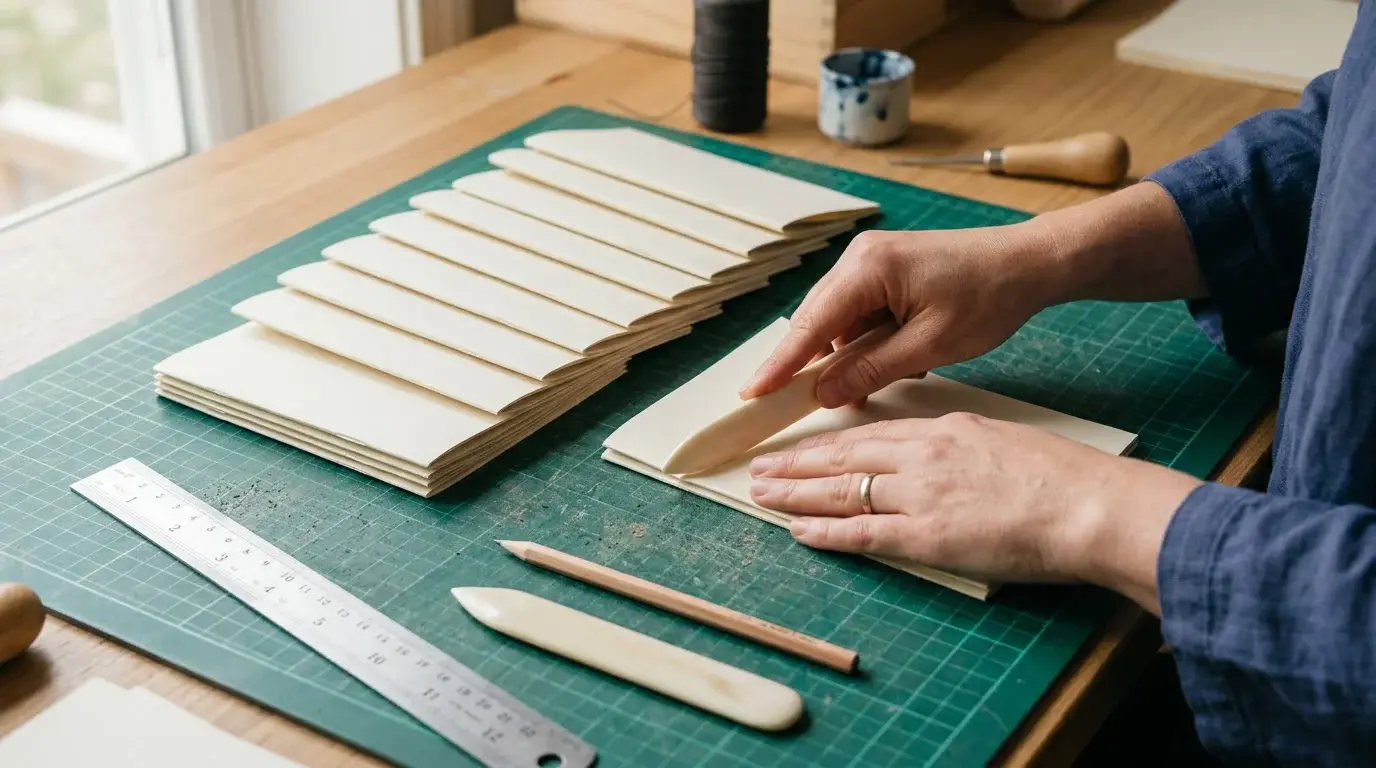
- Hold the sheet with one hand, flat, near the centre. With the other, take the bone folder and draw it from the middle of the fold outwards, with the lightest pressure that works.
- Then go back over it with more weight.
The order matters, and so does the restraint. Press hard at once and you will drag the sheet and leave a diagonal pucker. The second pass is where the crease becomes permanent. After it, the fold is a fact. You do not fold paper twice in the same place, and you do not unfold and re-fold to correct it.The exception is a fold you are going to burnish out in a restoration. That is a different craft with different rules and a lot more water. A crease is a decision, and it is made once.
From sheets to signatures
A single folded sheet gives four pages, which is not a book. Nest several folded sheets, one inside the next, and you have a signature, a little bundle of pages that will later be sewn as a unit. Mine are four sheets each, so sixteen pages to a signature, and there are seven of them. A modest total of one hundred and twelve pages, which turns out to be about the right size for a book you can finish.
Nesting is where tidiness pays. Each sheet sits inside the last, and because paper has thickness, the inner sheets stick out slightly at the open edge. This is called creep, and it is why books are trimmed. You can reduce it by folding the signature as a whole after nesting, with the bone folder running along the spine one last time. I did this with the folded edges toward me and the stack square against a steel rule, and I will admit that I enjoyed it more than most things I did that month.A bone folder is exactly what it sounds like: a flat piece of bone, rounded at one end and pointed at the other. Plastic ones work, but they shine the paper. Bone leaves it matte.
The mistake worth making
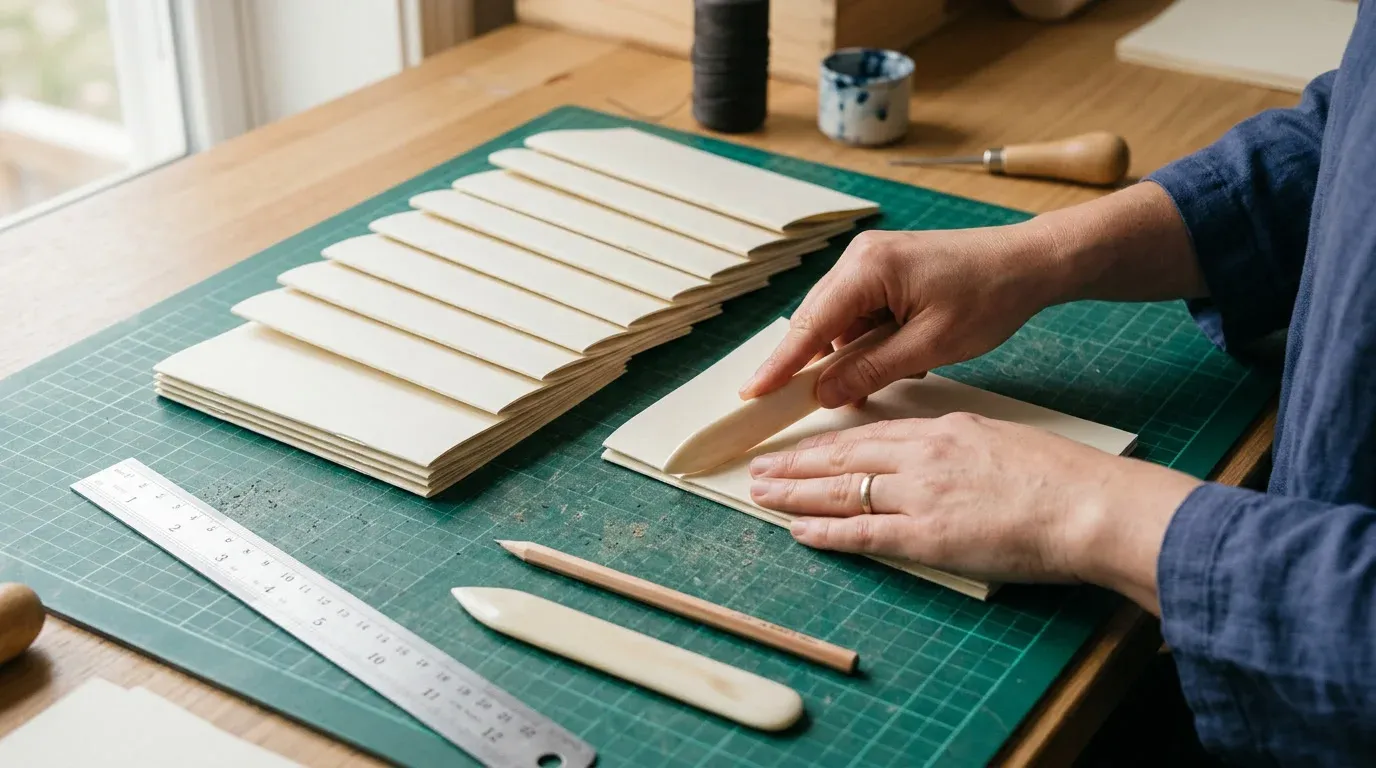
By the fourth signature I had a rhythm. By the fifth I had stopped paying attention. The sixth signature is the one in the photograph with a diagonal crease I will never forgive, and the funny thing is how exactly I know the moment it happened: I looked up to answer a message, and my hand carried on.
I could have thrown it away. Instead I put a small pencil cross on the corner and kept it. It will end up in the middle of the book, where the crease will be hidden by the gutter. Nobody will ever know, except now you do, and the book is better for having a flaw I have named. The point of working by hand is not to produce flawless objects. The machine does that. It is to be present at the moment when the flaw happens, and to decide what to do about it.
Where we stand
At the end of the evening there were seven signatures on the table and a pile of offcuts. My hands smelled of paper, which is a smell nobody warns you about, faintly sweet and a little dusty. I stacked the bundles in order, put a plank on top with two bricks for weight, and went to bed.
Next time we sew them together, which means thread, a frame and the first of several mistakes you cannot undo.
If this was worth your time, there is a letter.
One short letter every Friday. No tracking, leave in one click.