A Book in Three Parts, part 3 of 3
Casing In
Glue, board and cloth, a night under a weight, and the moment a pile of thread and paper becomes a book.
In this essay
There is a phrase in bookbinding that I love for its modesty: casing in. It means putting the sewn text block inside its hard cover, and it is the stage at which a heap of folded paper stops being a project and becomes an object. The cover is made separately, as a flat case of board and cloth, and the book is slid into it, glued and pressed. A coat for the book.
It is also the stage where mistakes get permanent in a new way, because glue does not forgive.
The case
The case begins with board. I used two pieces of grey binder’s board, cut to the height of the book plus a few millimetres, and a narrow strip for the spine. The gap between the boards, called the joint, lets the cover hinge. Get it too narrow and the book will not open; too wide and the spine will flop.
The cloth is cut larger than the boards by about two centimetres on every side, so there is a margin to turn in. I chose a plain blue book cloth, the colour of old ink, and spent twenty minutes deciding, which is a good deal longer than I spent on the typeface.
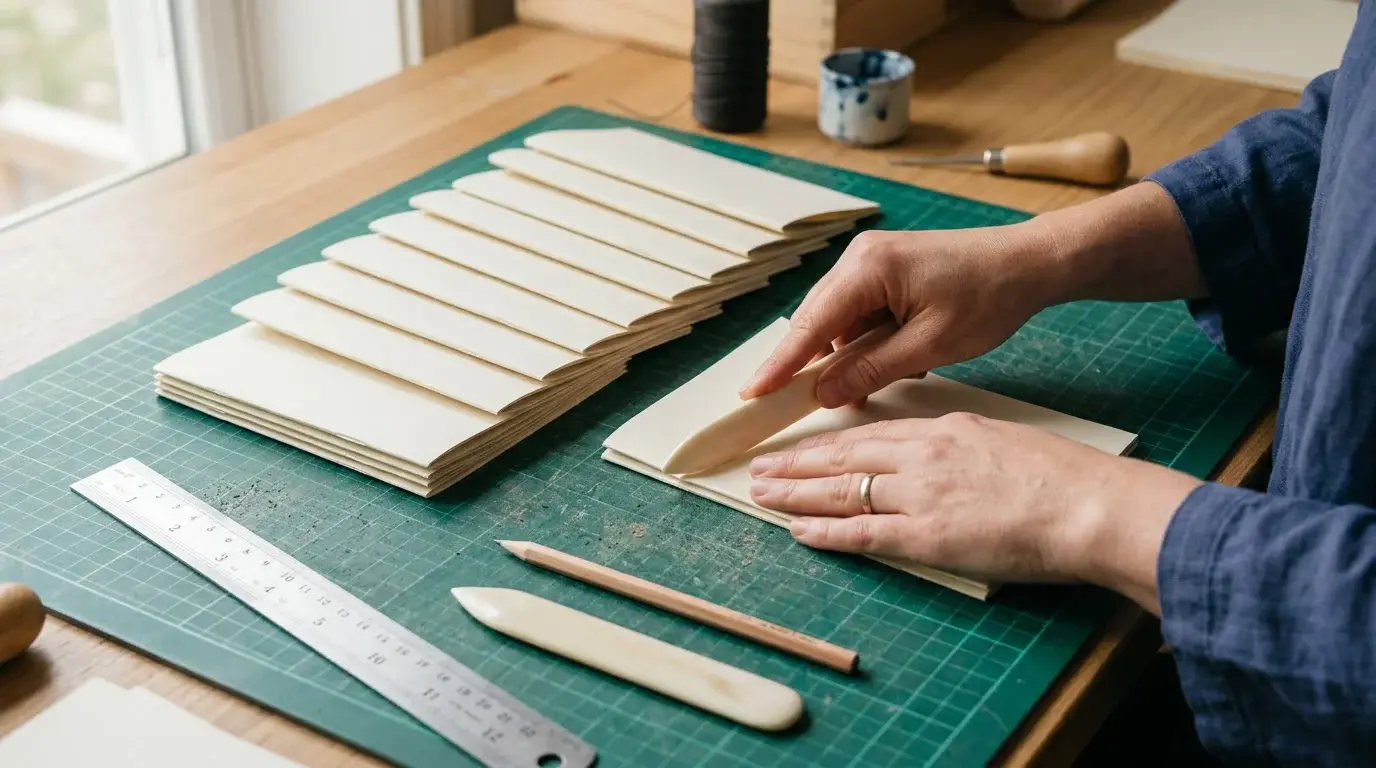
Then: paste. Not glue, paste, a mixture of wheat starch and water cooked until it is glossy, which stays workable for several minutes and can be repositioned. I brushed it onto the cloth in a thin even coat, working outwards, and laid the boards on top with a clear gap for the spine. The cloth drinks the paste and goes slightly dark. The corners are mitred, the edges turned in with the bone folder and rubbed down firmly.
The text block, prepared
While the case dries, the text block gets its own dressing. The spine is glued, a thin layer, and a strip of fine cotton mull is laid across it, overhanging by about three centimetres on each side. This is the part that actually holds the book to its cover. Over it goes a piece of paper called the spine lining, and the whole thing is rounded very gently with a hammer, so that the spine curves in a shallow arc. This is called, with unusual honesty, backing.
I will confess that I almost skipped backing. It seemed like decoration. It is not. A flat spine pulls away from the fore-edge as the book is read; a rounded one lets the pages fan out. The curve is mechanical, and it is the reason hand-bound books fall open in the right places.
The endpapers
The last piece before casing in is the endpapers: two folded sheets of heavier paper, one at each end of the block, pasted to the first and last signatures. When the book is cased in, the outer half of each endpaper is pasted down to the inside of the board, hiding the raw mull and the edges of the cloth. They are the quiet decorative moment of a binding, and I chose a pale grey that disappears.
The moment
Everything meets. The text block is placed in the case, with the spine centred in the joint. I eased it into position and checked the squares, the little overhang of cover past the pages, by eye, front and back. Then, with a clean brush, I pasted the endpapers, closed the cover on each side in turn, and smoothed each pastedown from the spine outward with the flat of my hand.
The book is now stuck to its cover, and nothing can be adjusted. I stood there for a moment with my hands on it. It was warm from the paste and smelled of starch and cloth, a smell that turns up in old libraries when the weather is damp.
A night under a weight
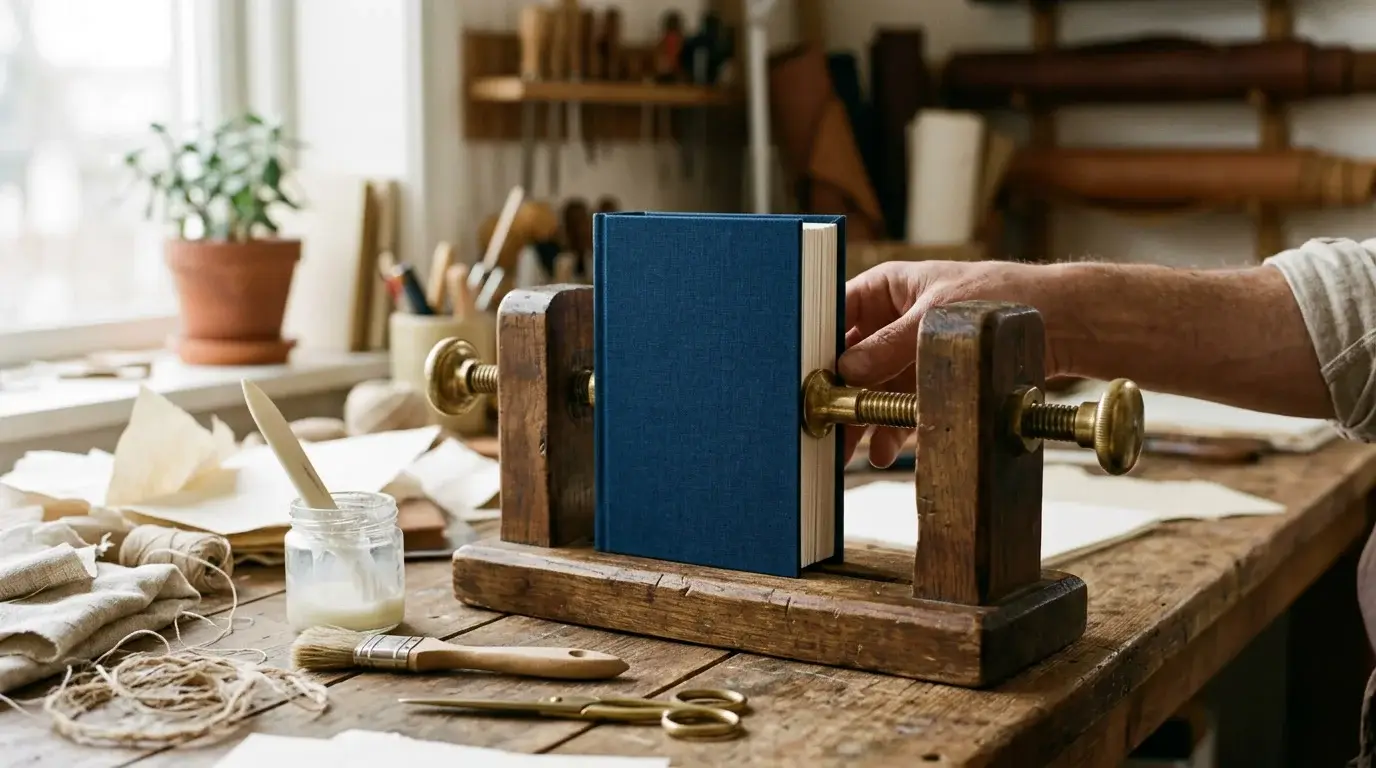
The finished book goes into a press overnight, between boards with wax paper at the endpapers to stop the paste from bleaching into the cloth. I used a small wooden press that belongs to the workshop, tightened by hand until the screws resisted, and then a quarter-turn more.
In the morning I took it out and opened it.
It opened as a book. The pages fell where they should, the spine curved, the front board lifted without effort. The kettle stitch I regret was invisible. The slightly crooked crease on the sixth signature was where I had hidden it, in the gutter. There was a small grey mark on the back cloth where a thumb had touched paste, which I will see every time I look at it.
I put it on the shelf and left it there for a week. Then I took it down and started writing in it, on the first page, in pencil, a single sentence: the date, and the word begin.
What the series was for
I set out to make one book so that I would understand what a book is. I can now say it in a sentence, which I could not before: a book is a series of small decisions made in an order that does not allow them to be undone. Whatever else the craft is, it is a long exercise in committing. That is the thing I took to the bench, and the thing I try, not always successfully, to bring to the desk.
If this was worth your time, there is a letter.
One short letter every Friday. No tracking, leave in one click.